|
DIGITAL
PHOTOCOPIER
Xerox Positioned in Leaders Quadrant Gartner released the 2008 Magic Quadrant for Managed Print Services (MPS) Worldwide report and Xerox was positioned in the Leaders Quadrant. We believe Xerox's leadership position speaks to our relentless attention to helping customers achieve a well-managed, highly productive, office print environment. |
|
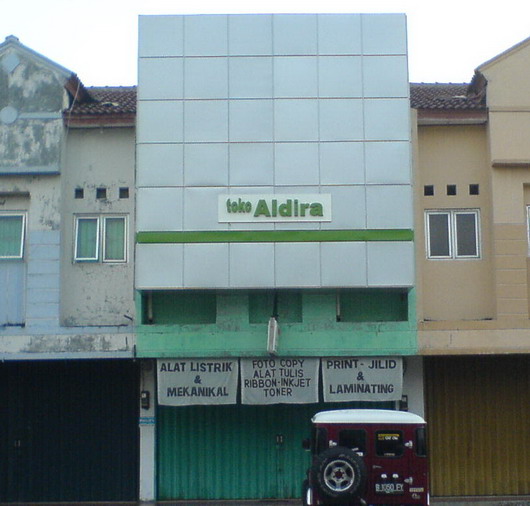
CV.
Aldira adalah perusahaan yang bergerak
di bidang pemasok barang dan jasa
Service kami : Pembelian dengan Pembayaran Tunda dan Gratis Biaya Antar Team management kami Selalu Siap melayani Anda |
|
|
 |
WIKIPEDIA
|
Photocopier A photocopier (or copier) is a machine that makes paper copies of documents and other visual images quickly and cheaply. Most current photocopiers use a technology called xerography, a dry process using heat. (Copiers can also use other output technologies such as ink jet, but xerography is standard for office copying.) Xerographic office photocopying was introduced by Xerox in the 1960s, and over the following 20 years it gradually replaced copies made by Verifax, Photostat, carbon paper, mimeograph machines, and other duplicating machines. The prevalence of its use is one of the factors that prevented the development of the paperless office heralded early in the digital revolution. Photocopying is widely used in business, education, and government.
There have been many predictions that photocopiers will eventually become
obsolete as information workers continue to increase their digital document
creation and distribution, and rely less on distributing actual pieces
of paper. However, photocopiers are undeniably more convenient than computers
for the very common task of creating a copy of a piece of paper. Colored toner became available in the 1950s, although full-color copiers were not commercially available until 3M released the Color-in-Color copier in 1968, which used a dye sublimation process rather than conventional electrostatic technology. The first electrostatic color copier was released by Canon in 1973. Color photocopying is a concern to governments, as it facilitates counterfeiting currency. Some countries have incorporated anti-counterfeiting technologies into their currency specifically to make it harder to use a color photocopier for counterfeiting. These technologies include watermarks, microprinting, holograms, tiny security strips made of plastic (or other material), and ink that appears to change color as the currency is viewed at an angle. Some photocopying machines contain special software that can prevent copying currency that contains a special pattern. Digital technology In recent years[when?], all new photocopiers have adopted digital technology, thus replacing the older analog technology. With digital copying, the copier effectively consists of an integrated scanner and laser printer. This design has several advantages, such as automatic image quality enhancement and the ability to "build jobs" (that is, to scan page images independently of the process of printing them). Some digital copiers can function as high-speed scanners; such models typically offer the ability to send documents via email or to make them available on file servers. A great advantage of digital copier technology is "automatic digital collation." For example, when copying a set of 20 pages 20 times, a digital copier scans each page only once, then uses the stored information to produce 20 sets. In an analog copier, either each page is scanned 20 times (a total of 400 scans), making one set at a time, or 20 separate output trays are used for the 20 sets. Low-end copiers also use digital technology, but tend to consist of a standard PC scanner coupled to an inkjet or low-end laser printer, both of which are far slower than their counterparts in high-end copiers. However, low-end scanner-inkjets can provide color copying at a far lower cost than can a traditional color copier. The cost of electronics is such that combined scanner-printers sometimes have built-in fax machines. Electrical Electrical engineering, sometimes referred to as electrical and electronic engineering, is a field of engineering that deals with the study and application of electricity, electronics and electromagnetism. The field first became an identifiable occupation in the late nineteenth century after commercialization of the electric telegraph and electrical power supply. It now covers a range of subtopics including power, electronics, control systems, signal processing and telecommunications. Electrical engineering may or may not include electronic engineering. Where a distinction is made, usually outside of the United States, electrical engineering is considered to deal with the problems associated with large-scale electrical systems such as power transmission and motor control, whereas electronic engineering deals with the study of small-scale electronic systems including computers and integrated circuits.[1] Alternatively, electrical engineers are usually concerned with using electricity to transmit energy, while electronic engineers are concerned with using electricity to transmit information.
Before the invention and adoption of the printing
press, almost all books were copied by hand, making books expensive
and comparatively rare. |
Pencil A pencil is a writing or drawing instrument consisting of a thin stick of pigment (usually graphite, but can also be coloured pigment or charcoal) and clay, usually encased in a thin wood cylinder, though paper and plastic sheaths are also used. Pencils are distinct from pens, which use a liquid marking material. |
Caculator A calculator is device for performing mathematical
calculations, distinguished from a computer by its having a limited
problem solving ability and an interface optimized for interactive
calculation rather than programming. Calculators can be hardware or
software, and mechanical or electronic, and are often built into devices
such as PDAs or mobile phones. Modern electronic calculators are generally small, digital, (often pocket-sized) and usually inexpensive. In addition to general purpose calculators, there are those designed for specific markets; for example, there are scientific calculators which focus on advanced math like trigonometry and statistics, or even have the ability to do computer algebra. Modern calculators are more portable than most computers, though most PDAs are comparable in size to handheld calculators. |
Photocopier A photocopier (or copier) is a machine that makes paper copies of documents and other visual images quickly and cheaply. Most current photocopiers use a technology called xerography, a dry process using heat. (Copiers can also use other output technologies such as ink jet, but xerography is standard for office copying.) Xerographic office photocopying was introduced by Xerox in the 1960s, and over the following 20 years it gradually replaced copies made by Verifax, Photostat, carbon paper, mimeograph machines, and other duplicating machines. The prevalence of its use is one of the factors that prevented the development of the paperless office heralded early in the digital revolution. Photocopying is widely used in business, education, and government. There have been many predictions that photocopiers will eventually become obsolete as information workers continue to increase their digital document creation and distribution, and rely less on distributing actual pieces of paper. However, photocopiers are undeniably more convenient than computers for the very common task of creating a copy of a piece of paper. |